
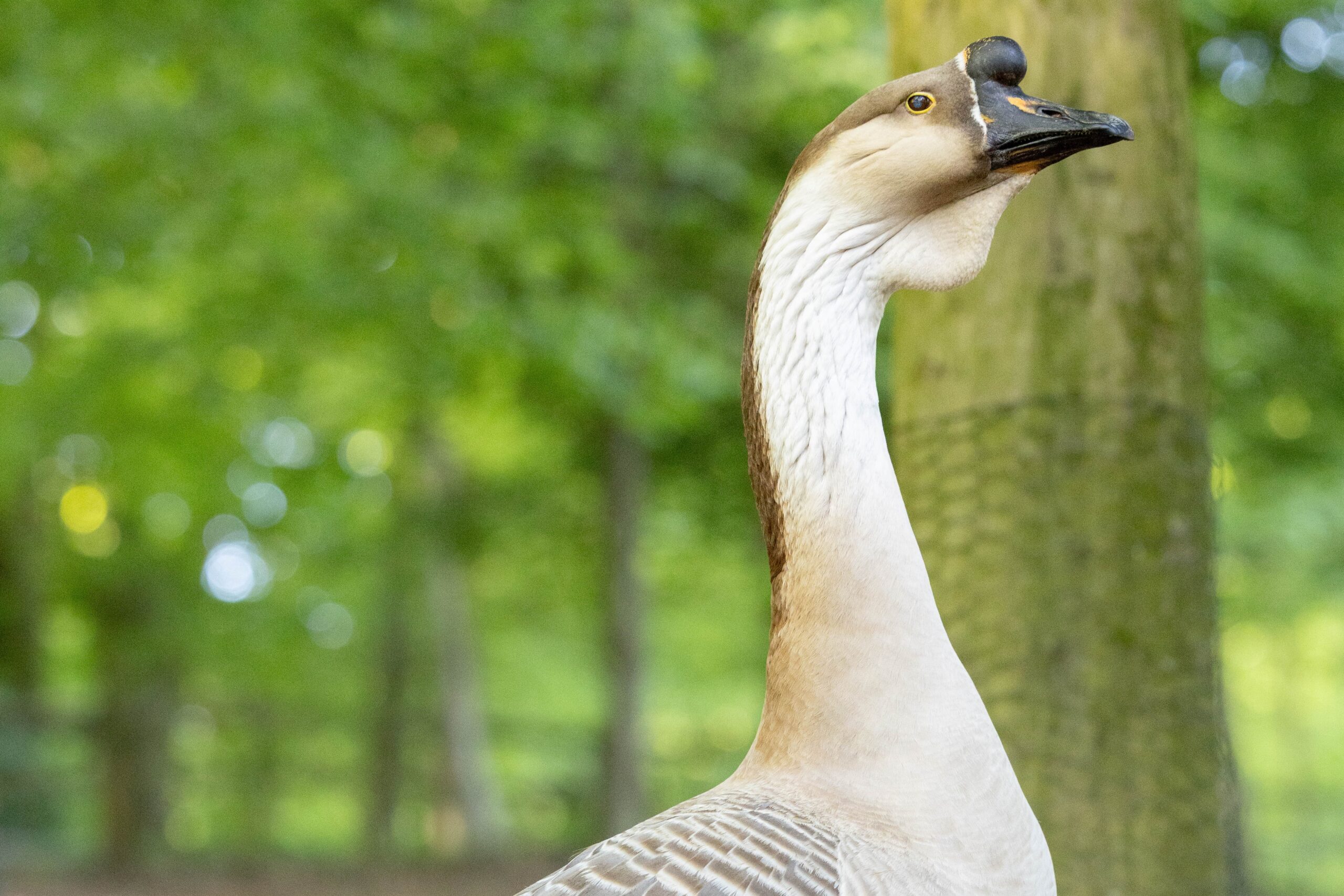
Die Höckergans ist eine domestizierte Gänserassen, welche von der asiatischen Schwanengans abstammt. Sie wurde in China, teils auch in Japan und Russland gezüchtet und gelang im 18. Jahrhundert nach Europa. Typisch für die Höckergans ist der namensgebende, auffällige Höcker auf der Stirn über dem Schnabel. Die Höckergans findet man in zwei verschiedenen Farbschlägen. Zum einen können sie gräulich braun gefärbt sein mit einem Aalstrich von Kopf bis Rücken und einem dunklen Schnabel und Höcker. Es gibt die Höckergans aber auch in weiß mit orangenem Schnabel und Höcker. Höckergänse sind vor allem in Asien wirtschaftlich relevant, da sie im Vergleich zu anderen Gänsen eine hohe Legeleistung haben; sie können jährlich 40-60 Eier legen.
The Chinese goose is a domesticated breed of goose that descends from the Asian swan goose. It was bred in China, and partly in Japan and Russia, and was introduced to Europe in the 18th century. A distinctive feature of the Chinese goose is the characteristic knob on its forehead above the beak, which gives the breed its name. Chinese geese occur in two different color varieties. They can be greyish-brown, with a dark stripe running from the head down the back and a dark beak and knob. They also exist in a white variety, with an orange beak and knob. Chinese geese are particu-larly important in Asia, as they have a high egg-laying capacity compared to other geese, producing around 40–60 eggs per year.